May 29, 2026
Thank you to the many coalition partners, legislators, and community members who advocated alongside us for economic justice and racial equity in the 2026 General Assembly! Together we achieved several victories and set the stage for future advocacy. Among this year’s accomplishments are laws that will:
- Strengthen fair housing law by placing guardrails on when and how corporate landlords can deny someone housing based on long-past criminal records and closing loopholes in Maryland’s law against source-of-income discrimination;
- More than double funding for the Community Schools Rental Assistance Program;
- Require hospitals to create staffing committees and staffing plans to reduce unsafe levels of staffing at Maryland hospitals;
- Increase access to Temporary Cash Assistance for families with children;
- Require the Department of Public Safety and Correctional Services to issue a report on its treatment of incarcerated trans people;
- Reduce the number of criminal charges that result in children being automatically charged as adults; and
- Protect schools from participation in immigration enforcement activities.
In addition, we continue to advocate through the National Coalition for a Civil Right to Counsel, tracking federal and state-level bills across the country to enact, change, or repeal a right to counsel in key areas, including housing (primarily eviction cases), family law, domestic violence, guardianship, immigration, civil forfeiture, civil incarceration, and education.
Read on to learn about victories, successful efforts to defeat harmful bills, as well as legislation we’ll be bringing back in future years.
Human Right to Housing
Workplace Justice
Health and Benefits Equity
Education Stability
National Coalition for a Civil Right to Counsel
Human Right to Housing
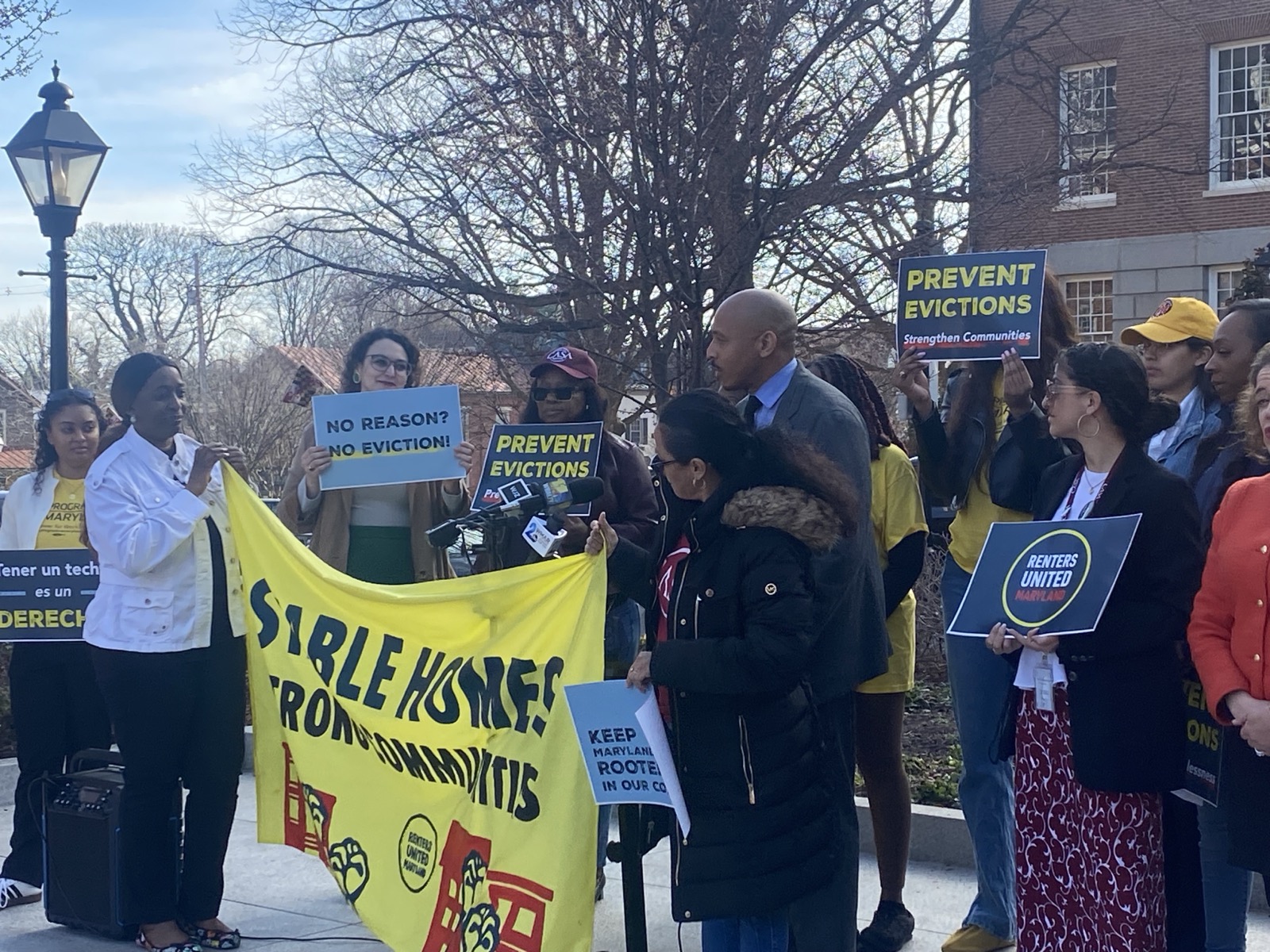
The PJC joined Maryland renters, community groups, and other advocates in leading successful campaigns that will create more stable homes and stronger communities. This includes passing the Fair Chance in Housing Act, passing a state budget that more than doubles funding for the Community Schools Rental Assistance Program, and strengthening Maryland’s fair housing law that protects renting families who use a voucher to pay part of the rent. We continued to push for “Good Cause Eviction” legislation, which would have allowed Maryland counties to pass laws to stop corporate landlords from evicting renters without providing a good reason. We also defeated two bills that would have made renting families less safe in their homes.
We’re grateful for the partnership of the many people and organizations who contributed to the fight for housing justice. Thank you to all the members of Renters United Maryland, including the steering committee (CASA, Progressive Maryland, Jews United for Justice, the Legal Defense Fund, and Economic Action Maryland), as well as BUILD, Advance Maryland, the Vera Institute of Justice, and the Baltimore Regional Housing Partnership. We thank bill sponsors Senators Shaneka Henson, Shelly Hettleman, Sara Love, Anthony Muse, Charles Sydnor, III, and Chris West and Delegates Robbyn Lewis, Vaughn Stewart, Jheanelle Wilkins, Deni Taveras, Mary Lehman, and Elizabeth Embry. We’re also grateful for the support Delegates Lorig Charkoudian, Marlon Amprey, Kris Valderrama, and Ben Barnes and Senators Will Smith and Guy Guzzone.
Fair Chance in Housing Act (SB 937 / HB 1073)
As the federal government abandons its role in enforcing civil rights, the passage of the Fair Chance in Housing Act (Senator Henson and Delegate Lewis) will place guardrails on when and how corporate landlords can deny someone housing based on long-past criminal records. Everyone deserves a fair chance at accessing housing, and SB 937 / HB 1073 will ensure that residents who have served their time will not be automatically denied housing. We remain concerned about how this law will be enforced and hope to work closely with the Maryland Attorney General. The Governor has signed the bill.
Funding to prevent the eviction of families with children through the Community Schools Rental Assistance Program (state budget)
Created in 2024 by legislation sponsored by Senator Shelly Hettleman and Delegate Vaughn Stewart, the Community Schools Rental Assistance Program (CSRAP) helps stop the evictions of families whose children are enrolled in community schools. In 2026, the General Assembly more than doubled (from $5 million to $11 million) the Governor’s budget for CSRAP, which will keep nearly 2,500 families with children from facing eviction and possible homelessness in the coming year. Keeping families in their homes gives children the stability they need to thrive in school.
Addressing discriminatory tenant screening practices (SB 335 / HB 315)
We successfully advocated for legislation that will strengthen Maryland’s fair housing law to protect tenants who use a housing voucher to pay rent. Sponsored by Senator Sara Love and Delegate Vaughn Stewart, SB 335 / HB 315 will stop landlords from using arbitrary income and credit tests that have no relationship to a voucher-holding renter’s ability to pay the rent. The Governor has signed the bill.
Establishing local enabling legislation for Good Cause Eviction (SB 462 / HB 774)
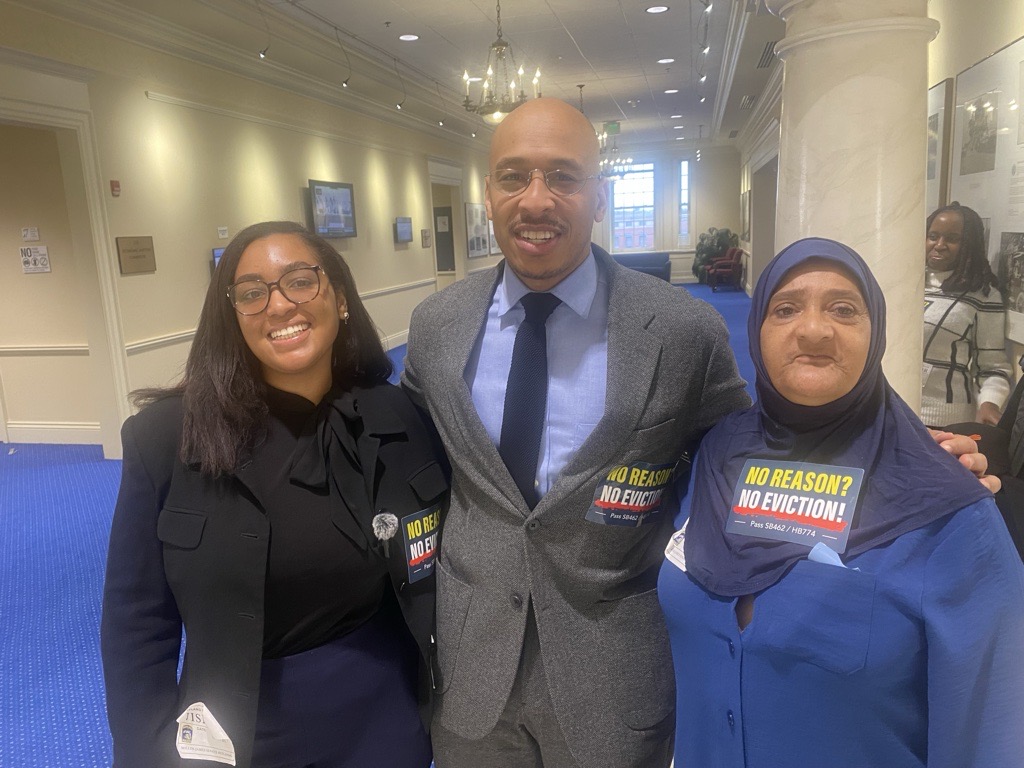
All Marylanders deserve the chance to put down roots in our communities, but for too long corporate landlords have rigged the rules to their benefit – filing eviction cases against thousands of Maryland families each year without providing a reason. This year we continued to advocate for Good Cause Eviction legislation with bill sponsors Delegate Jheanelle Wilkins and Senator Anthony Muse, which would have allowed counties to pass laws that require corporate landlords to state the reason for terminating a renting family’s tenancy. Good Cause Eviction would have supported housing stability and affordability for Maryland families in the midst of economic chaos and an unaffordable market. Unfortunately, while the bill once again passed the House, the Senate refused to act for the second time in three years.
Opposing bills that would have hurt Maryland’s renting families
We defeated bills that would have made renting families less safe in their homes. HB 59 and HB 847 would have stripped Maryland residents of the right to a fair hearing before an eviction whenever a property owner – often falsely – accused them of squatting. SB 589 / HB 433 would have given landlords a special exemption from debt collector licensing laws. Debt collectors and landlords need more oversight, not less.
Other notable housing justice legislation:
- Enshrining federal fair housing protections in state law (HB 573 / SB 274). This bill aligns Maryland law with current federal guidance for certain fair housing cases related to “disparate impact” discrimination. A housing practice or policy has a disparate impact when it disproportionately harms people of color or other protected groups without a substantial justification. HB 573 / SB 274 (Delegate Taveras / Senator Sydnor) ensures that even as the Trump Administration dismantles disparate impact protections, Maryland residents will still be protected from this insidious form of discrimination. The Governor has signed the bill.
- Establishing air conditioning requirements in apartments (HB 153 / SB 12). This bill will require apartments that are equipped with air conditioning to maintain a temperature of 80° F or cooler during the summer season. Sponsored by Delegate Mary Lehman and Senator Chris West, the legislation also requires installation of air conditioning systems in newly constructed or substantially renovated properties. The bill applies to properties with ten or more residential rental units. The Governor has signed the bill, and it takes effect on June 1.
- Mobile Home Residents’ Right to Counsel in Evictions (SB 729) clarifies that Maryland’s landmark Access to Counsel in Evictions law applies to mobile home residents, who own their home but rent the ground on which it lies. Sponsored by Senator Shaneka Henson, the legislation supports the economic stability of thousands of mobile home residents who own their home but face total loss of their asset in an eviction. The Governor has signed the bill.
- Safe and Healthy Homes for All Act (HB 1218 / SB 941). Sponsored by Delegate Jheanelle Wilkins and Senator Shaneka Henson, this bill requires the state Department of Housing and Community Development (DHCD) and the Office of the Attorney General to identify predatory landlords, identify multi-family properties throughout Maryland that pose severe health and safety risks, and create a comprehensive intervention plan. DHCD must report to the Governor and the General Assembly on or before December 31, 2027. The Governor has signed the bill.
- Rental Fraud Prevention Act (HB 1456). Sponsored by Delegate Elizabeth Embry, this bill would have ensured that internet-based companies verify that anyone posting a property “for rent” is authorized to do so by the owner. This bill is a critical part of any campaign to address “scamlord” operations and protect both renters and property owners. While the bill passed the House with bipartisan support, the Senate refused to take action.
- Tenant Screening Transparency Act (HB 313). Sponsored by Delegate Vaughn Stewart, this bill would have required more transparency from landlords in explaining why they are denying a prospective tenant’s application. The bill passed the House, but the Senate refused to act.
The PJC’s Human Right to Housing team members advocating for these bills included Matt Hill, Albert Turner, Samantha Gowing, Angelea Aldana Dwyer, Carolyn Johnson, Elizabeth Ashford, Carolina Paul, Omar Arar, Elaineh Paulino, and Najá Crockett.
Workplace Justice
This year, we worked with our coalition partners to advocate for a variety of bills that would improve wages and workplace protections for all workers. In our Caring Across Maryland coalition, we know that care should be at the heart of our healthcare system and workplaces. But too often, these systems are set up in ways that undermine the well-being of patients and workers. Our advocacy sought to improve conditions for workers and patients. We successfully advocated with the Caring Across Maryland coalition to pass the Safe Staffing Act to ensure adequate staffing in hospitals. We also pushed for policies that would have increased the minimum wage, bolstered jobs for care workers, increased access to care, and improved transparency and oversight of nursing homes, hospitals, and adult care facilities.
Safe Staffing Act of 2026 (SB 411 / HB 624)
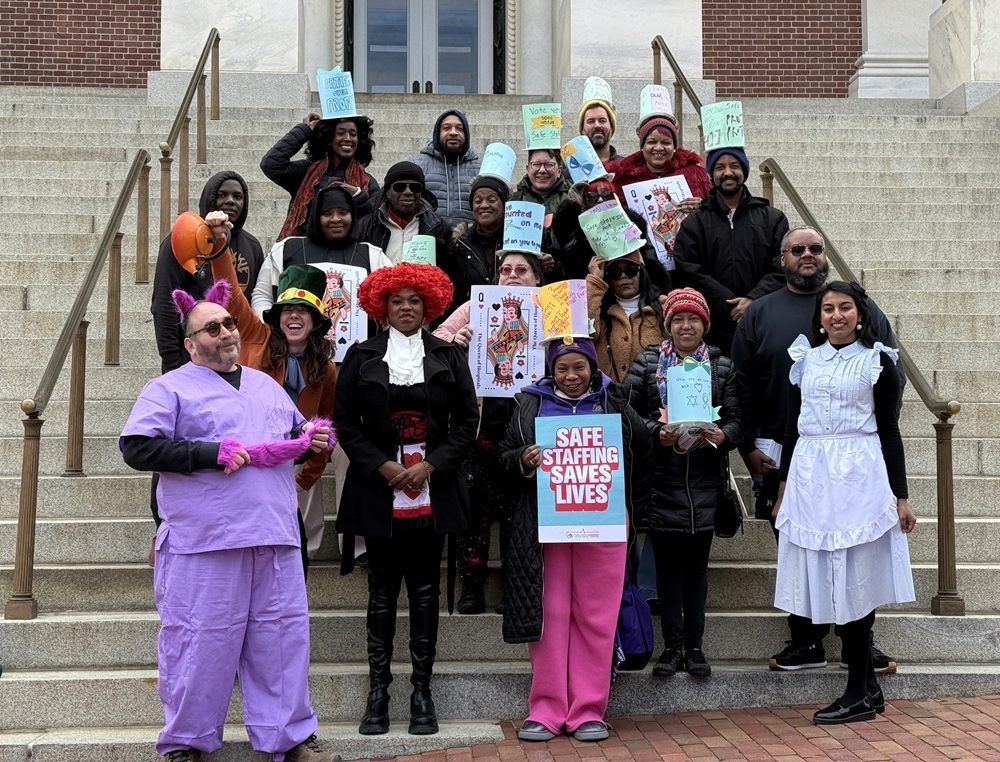
Maryland hospitals face critical staffing shortages due to high staff turnover, poor working conditions, low pay, and shifting care delivery models. When hospitals assign nurses too many patients, the quality of care that people receive suffers. Nurses become burned out and are more likely to leave the profession. After three years of hard work, we successfully advocated to pass the Safe Staffing Act, which requires hospitals to create staffing committees and staffing plans to reduce unsafe levels of staffing at Maryland hospitals. The Governor has signed the bill. By creating safe staffing conditions, hospitals can retain experienced nurses, motivate people to join or come back to the profession, and help ensure patients get the care they need. Thank you to 1199 SEIU, Caring Across Maryland, the Patient-Worker Collaborative, and bill sponsors Senator Malcolm Augustine and Delegate Jennifer White Holland for championing the bill.
Minimum wage for home care workers and paid sick leave (HB 1129)
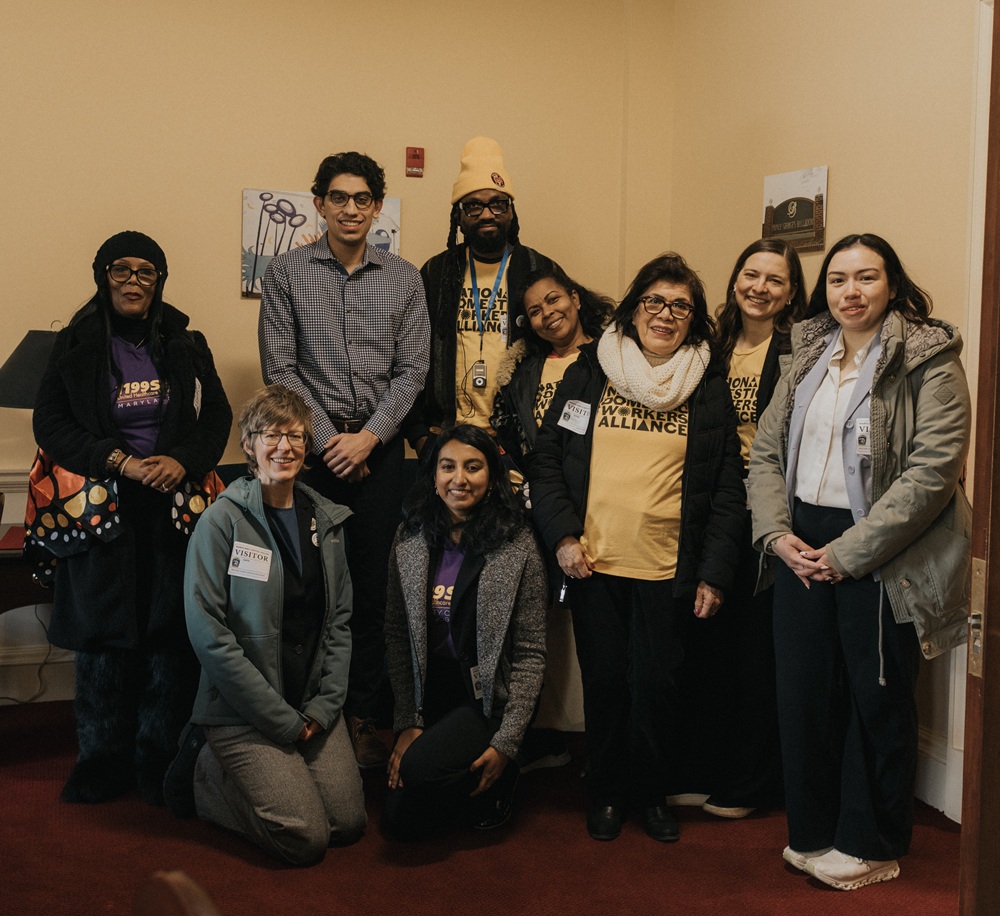
While the demand for home care is high, home care workers receive very low wages, and many do not receive paid sick and safe leave. We advocated for legislation that would have required residential service agencies to increase home care workers’ wages to at least $20 per hour and provide paid sick and safe leave to home care workers, regardless of the size of the agency. Unfortunately, the bill did not receive a committee vote due to opposition from the home care industry. Thank you to the National Domestic Workers Alliance, Caring Across Maryland, and bill sponsor Delegate Lesley Lopez for their partnership in the fight for living wages and paid leave.
Nursing Home Staffing Crisis Funding Act of 2026 (SB 663 / HB 1414)
There is little transparency into – and oversight over – nursing home spending, which contributes to high staff turnover, substandard working conditions, and poor quality of care. Even though Medicaid reimbursement rates to providers have increased, frontline workers do not receive family-sustaining wages. Meeting patients’ medical needs requires an investment in training and wages for direct care workers. The Nursing Home Staffing Crisis Funding Act sought to improve nursing homes’ fiscal transparency and ensure that 75% of nursing facility revenue would be spent on direct care wages and benefits for direct care workers to reduce staff turnover and improve patient outcomes. The bill did not receive a committee vote. Thank you to 1199 SEIU, Caring Across Maryland, and bill sponsors Senator Benjamin Kramer and Delegate Ashanti Martinez for their support.
Maryland Living Wage for All (SB 886 / HB 1229)
Maryland workers deserve to be paid enough to meet the cost of living. But Maryland’s current minimum wage of $15 per hour is not enough for individuals and families to afford necessities like housing, food, transportation, and healthcare. And the minimum wage for people who earn tips is even lower, a practice that is a direct legacy of slavery. As a member of the Maryland Living Wage for All coalition, we advocated for legislation that would have sent a living wage amendment to the state constitution to the ballot in the 2026 general election. The amendment would have permanently tied the state’s minimum wage to the cost of living and require all employers to pay employees at least the full minimum wage, eliminating the subminimum wage for tipped workers. The bill did not receive a committee vote in either the Senate or House of Delegates. Thank you to the Maryland Living Wage For All Coalition for leading advocacy for the bill, including members One Fair Wage, 1199 SEIU, CASA, AFSCME, Maryland State Education Association, Maryland Center on Economic Policy, and the AFL-CIO, as well as bill sponsors Delegate Vaughn Stewart and Senator Anthony Muse.
Additional advocacy for workplace protections and paid leave
We also supported several bills through written and oral testimony that would have strengthened workplace protections and availability of paid leave, including caregiver anti-discrimination protections (HB 724), expansion of qualifying family members for bereavement leave (HB 1241), collective bargaining rights for warehouse workers (HB 1108 and SB 887), and paid leave for attendance at school functions (HB 1524). While none of these measures passed this year, we are hopeful they will be taken up in future years to provide important protections for workers.
The Workplace Justice Project team members advocating for these bills included Nicole Tortoriello, Sam Williamson, Amy Gellatly, and Jahira Padilla Diaz.
Health and Benefits Equity
Access to healthcare and safety net services is a human right, but many systemic barriers keep people from attaining their highest level of health. We advocate to protect and expand access to healthcare and safety net services for Marylanders struggling to make ends meet. We support policies and practices that are designed to eliminate economic and racial inequities and enable every Marylander to attain their highest level of health. During the 2026 legislative session, we successfully advocated for legislation that will increase access to Temporary Cash Assistance for families with children and require the Department of Public Safety and Correctional Services to report on its treatment of incarcerated trans people. We also advocated for bills that would have improved access to prescriptions for gender-affirming care and hormone therapy, made it easier for transgender Marylanders to update their birth certificates, established a Stakeholder Advisory Council for the Office of Health Care Quality, and increased budgets for safety net services.
Increasing access to Temporary Cash Assistance for families with children (HB 1490)
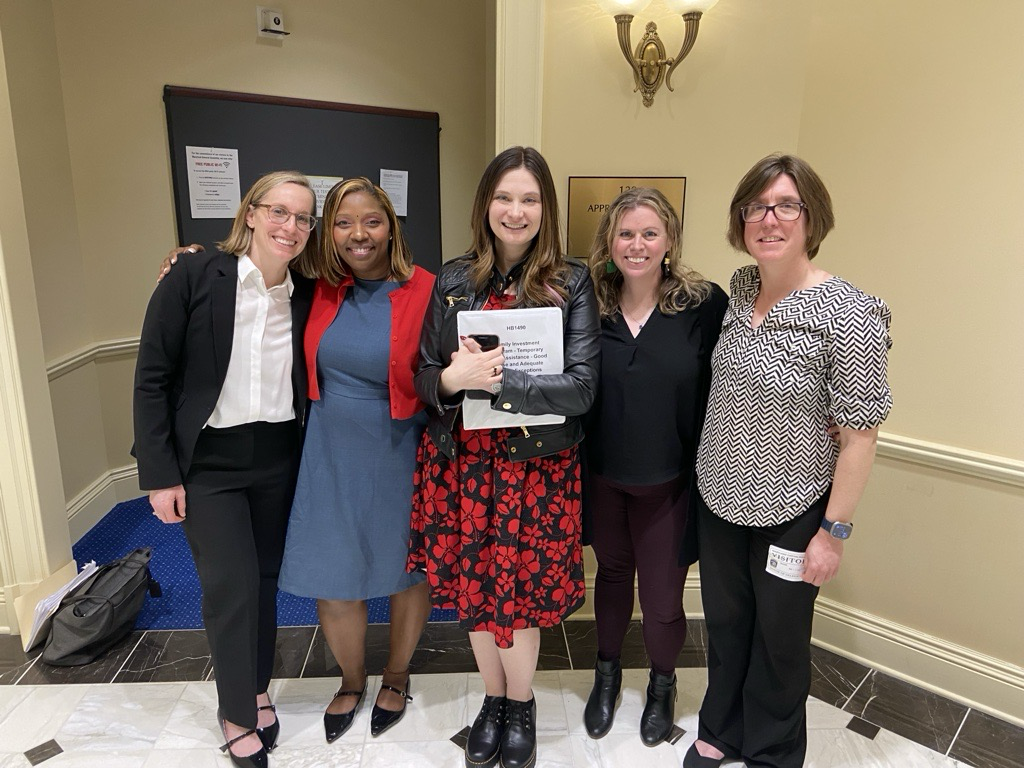
We celebrate the passage and Governor Moore’s recent signing of HB 1490, a bill that will significantly reduce barriers that families with children face when accessing the Temporary Cash Assistance (TCA) program. A leading cause of TCA application denials in Maryland has been a requirement for one-parent households applying for cash assistance to file for child support against the non-custodial parent of the child. This federal requirement is rooted in racist and sexist narratives and disproportionately harms Black women and children, people living with disabilities, and survivors of domestic violence. HB 1490 expands Maryland’s “good cause” exemptions from the child support requirement, allowing families flexibility when they are unable to apply for child support. The bill positions parents and care providers as the experts on determining what is in their children’s best interest and creates a standard process for the Department of Social Services to notify families on the existence of “good cause” and how to obtain it. HB 1490 is a landmark law that will pave the way for other states that similarly want to use allowable flexibility in the Temporary Assistance for Needy Families program to better support families with children experiencing income insecurity. The Governor has signed the bill, and it takes effect on October 1, 2026.
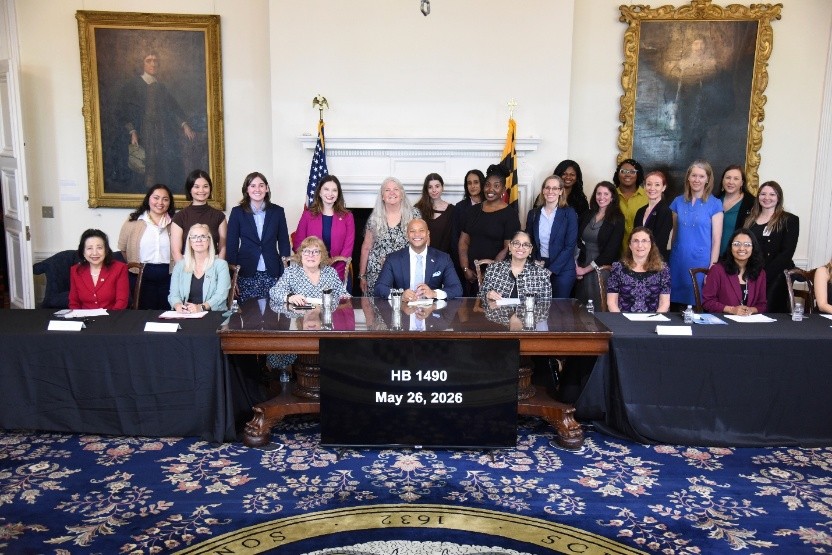
Thank you to bill sponsor Delegate Emily Shetty for her incredible dedication and for championing the bill, and the Maryland General Assembly for their work in passing HB 1490. We also thank the Maryland Department of Human Services for their support and feedback to ensure the legislation can be implemented. We are deeply grateful to parents with lived expertise who brought to light the need for this bill and advocated for its passage, including Mya Brown, Erika Young, Arieona Jefferson, Renaye Krug, Salieta Glenn, and Ms. Taylor. The PJC led advocacy on this bill, together with allies, including the Maryland Center on Economic Policy, Maryland Family Network, and Maryland Legal Aid.
Requiring the Department of Public Safety and Correctional Services to issue a report on its treatment of incarcerated trans people (state budget)
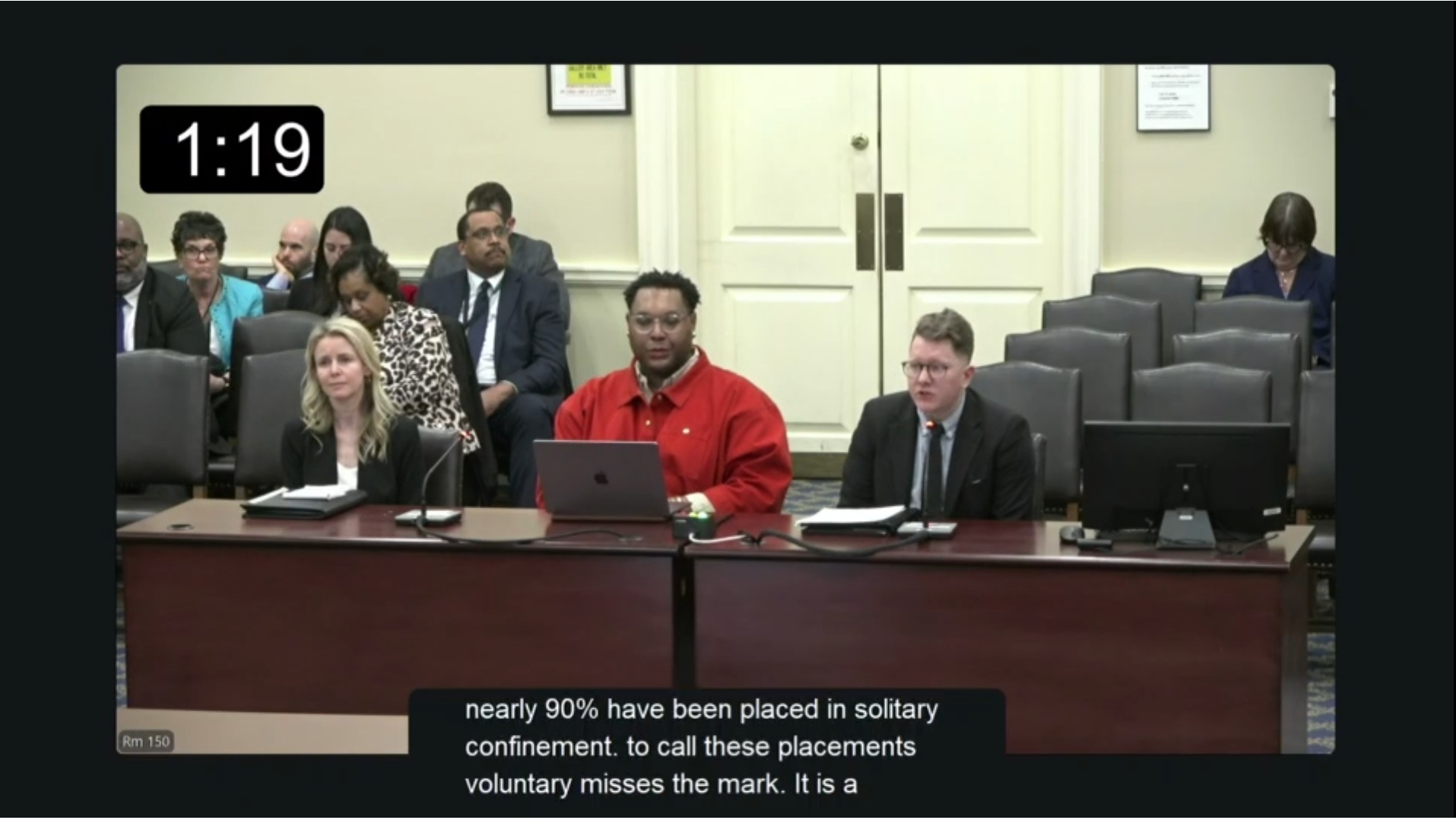
Policies and practices of the Maryland Department of Public Safety and Correctional Services (DPSCS) frequently harm incarcerated trans people. DPSCS fails to house people based on gender identity, does not adequately address the violence they face from staff and other incarcerated people and instead holds trans people in solitary confinement, and fails to provide sufficient access to healthcare, among other violations of the federal laws, including the Prison Rape Elimination Act. As a member of the Trans Rights Advocacy Coalition’s (TRAC) leadership team, the PJC successfully advocated for language in the state budget to require DPSCS to write a report on its treatment of incarcerated transgender individuals in Maryland. This was TRAC’s primary focus for the legislative session, and 2026 is the fourth year of requiring the department to write the report. The report is critical for shedding light on the experiences of incarcerated trans people and will enable greater accountability for mistreatment that people inside experience.
We thank TRAC, BALT, the University of Baltimore Center for Criminal Justice Reform, and Advance Maryland for their advocacy, and committee chairs Senator Shelly Hettleman and Delegate Gabriel Acevero for their oversight of DPSCS.
Improving access to prescriptions for gender-affirming care and hormone therapy (HB 1380)
Together with fellow members of TRAC, we supported HB 1380, which would have allowed patients to receive greater supplies of hormone therapy and therefore reduced barriers to refilling prescriptions. Unfortunately, this bill did not receive a committee vote. We thank sponsor Delegate Kris Fair for supporting the bill.
Birth Certificate Modernization Act (SB 626)
As a member of TRAC, we also supported the Birth Certificate Modernization Act, which would have made it easier for transgender Marylanders to update their birth certificates. This bill passed both chambers but ran out of time to go to conference committee over differences in amendments made in the House and Senate. Thank you to Senator Clarence Lam, Delegate Ashanti Martinez, and co-sponsors for supporting the bill.
Establishing a Stakeholder Advisory Council for the Office of Health Care Quality (SB 240 / HB 965)
Maryland’s Office of Health Care Quality (OHCQ) is entrusted with ensuring that Maryland patients receive adequate care and investigating complaints of abuse and neglect in Maryland healthcare facilities. Yet OHCQ has not been able to fulfill its mandate. Maryland has historically ranked among the worst states in timely oversight of nursing facilities. Although OHCQ testified that it has improved on the backlog for nursing facilities, whether that improvement can be sustained for nursing facilities or improved for assisted living programs and other institutions remains to be seen. To help hold OHCQ accountable, we advocated for SB 240 / HB 965, which would have established a Stakeholder Advisory Council for the Office of Health Care Quality. The bill would have allowed patients, frontline workers, and advocates to provide feedback to OHCQ on how to improve oversight of Maryland healthcare facilities as well as provide the public with ongoing data on OHCQ’s performance. Increasing accountability for timely investigations is essential to addressing unsafe conditions. Unfortunately, the bill did not receive committee votes. Thank you to Senator Lewis Young, Delegate Teresa Woorman, and co-sponsors for supporting the bill.
Budget advocacy to support a strong safety net for our client communities
The Health and Benefits Equity Project testified in support of budgets for safety net services for individuals and families with low incomes who are deeply impacted by HR 1, a federal budget bill that severely cut funds allocated to state Medicaid programs and the Supplemental Nutrition Assistance Program.
We testified in support of the budget for Maryland’s Medicaid program, a lifeline to care that supports about 25% of Marylanders. With approximately 130,000 Marylanders anticipated to lose their healthcare coverage through HR 1 implementation, we joined numerous allies in urging the Maryland General Assembly to protect the state budget from deeper cuts.
Together with other advocates, including Maryland Center on Economic Policy and Maryland Family Network, we successfully advocated at hearings before the House Appropriations’ Health and Social Services subcommittee and Senate Budget and Taxation Committee’s Health and Human Services subcommittee on the Department of Human Services Family Investment Administration (FIA) budget. Funding levels continued without cuts for critical food and cash antipoverty programs, including Temporary Cash Assistance (TCA), Temporary Disability Assistance Program (TDAP) and Supplemental Nutrition Assistance Program (SNAP). Our advocacy highlighting concerns with increased application denial rates and case closures also helped secure budget language requiring DHS to report quarterly to budget committees on application processing times, application denial rates, and case closures for benefit programs. Finally, DHS is required to report on the TCA benefit calculation by October 2026, in an effort to avoid delays that occurred in 2025 in implementation of a required benefit increase. We are grateful to subcommittee Chair Emily Shetty and Chair Cory McCray for their leadership, as well as members of each subcommittee for their work on the budget this year.
Advocates were successful in securing $500,000 in general funds to support Medicaid navigators to provide individual support to individuals at risk of coverage loss. Maryland’s historic budget deficit and forthcoming federal funding cuts made it a challenging year to secure substantial increases for programs funded by the state budget that support our client communities. But we will continue to center the experiences of our client communities and advocate for a stronger safety net in other forums.
The PJC’s Health and Benefits Equity team members advocating for these bills included Michelle Madaio, Sam Williamson, and Ashley Woolard.
Education Stability
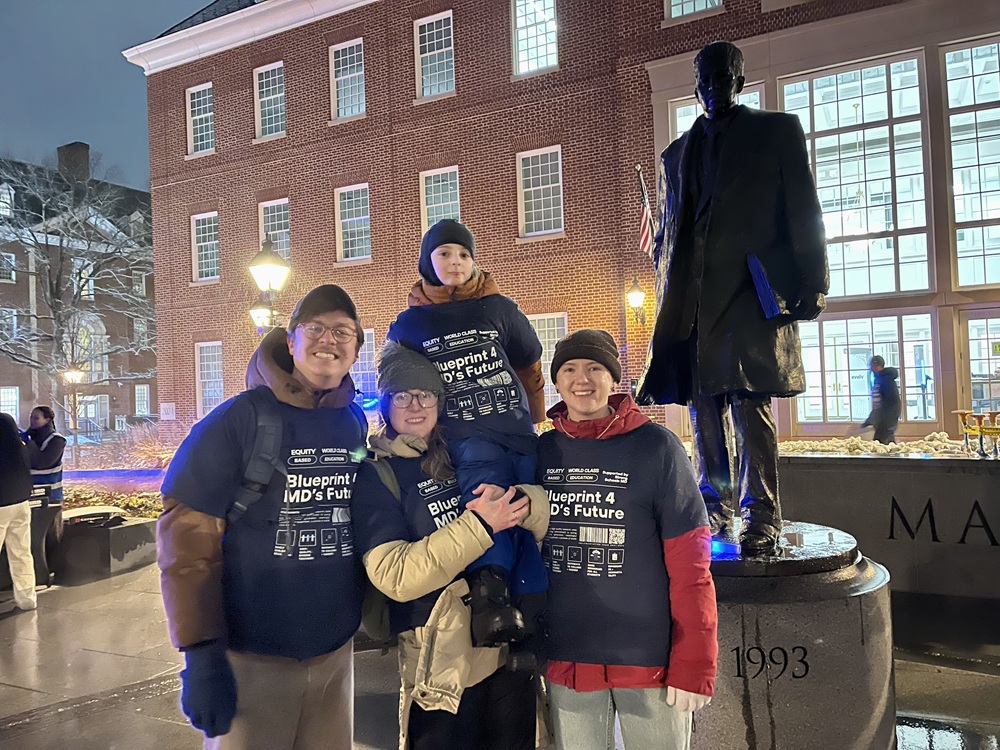
Every child should have access to an education. But numerous barriers can keep kids from succeeding in school. In this year’s legislative session, the Education Stability Project’s top priority was a bill to strengthen education anti-discrimination protections. We also submitted testimony in support of several other bills, including successful legislation to reduce the instances of automatic charging of youth as adults and to protect schools from participation in immigration enforcement activities. We were actively engaged in the Maryland Coalition to Reform School Discipline, Maryland Alliance for Racial Equity in Education, and Blueprint Coalition during the legislative session.
Advancing Equal Education Opportunities for All Maryland Students Act (HB 649)
Discrimination by educational institutions against students in protected classes—such as race, sex, sexual orientation, gender identity, disability, and national origin—deprives students of their fundamental right to education, stifles individual potential, and deepens societal inequity. This year, we led advocacy in partnership with the Maryland Commission on Civil Rights (MCCR) and a coalition of advocates for HB 649 to strengthen and expand state-level anti-discrimination protections and civil rights enforcement mechanisms for students. Gaps in Maryland’s current education anti-discrimination law combined with the lack of enforcement of federal education civil rights laws during the second Trump Administration have left Maryland students unprotected. Introduced by request of MCCR, HB 649 sought to extend protections to higher education students, who are not covered by Maryland’s current education anti-discrimination law; establish that MCCR has jurisdiction to investigate and resolve discrimination complaints; allow disparate impact discrimination claims rather than only claims alleging intentional discrimination; and create a private right of action enabling students and families to file a civil action in court. The bill passed the House and crossed over to the Senate but did not receive a committee vote in the Senate before the end of the session.
Thank you to MCCR for their leadership on HB 649 and to the Maryland State Department of Education and Maryland State Board of Education for supporting the bill. Thank you also to our partners at the Gibson Banks Center on Race and the Law at the University of Maryland Carey School of Law, Maryland Alliance for Racial Equity in Education, ACLU of Maryland, Disability Rights Maryland, and Maryland Coalition to Reform School Discipline.
Youth Charging Reform Act (HB 409 / SB 323)
We joined fellow advocates in advocating for a bill that reduces the number of criminal charges that result in children being automatically charged as adults in Maryland. While the PJC supports an end to the harmful practice of charging children as adults in its entirety, this represents incremental change towards limiting this harm. SB 323 passed, and the Governor signed it. Thank you to the bill sponsors, Delegate Sandy Bartlett and Senator Will Smith, and to Leaders of a Beautiful Struggle, the Maryland Youth Justice Coalition, and other lead advocates for their commitment to this issue.
Maryland Values Act of 2026 – Protecting schools from participation in immigration enforcement (HB 1341 / SB 810)
We successfully advocated for a bill that seeks to ensure that immigration enforcement activities do not interfere with Maryland students’ right to a public education. SB 810 prohibits public school personnel from being used for federal immigration enforcement efforts or from sharing student information for this purpose. It also requires public school personnel to notify the superintendent of the local school district if the personnel are notified of any immigration enforcement. Thank you to the bill sponsors, Delegate Eric Ebersole and Senator Nancy King, for their leadership. The Governor has signed the bill.
The PJC’s Education Stability team members advocating for these bills included Ingrid Löfgren, Levi Bradford, and Kelsey Carlson.
National Coalition for a Civil Right to Counsel
The National Coalition for a Civil Right to Counsel (NCCRC), a project of the Public Justice Center, is the only entity in the country dedicated solely to advancing the right to counsel in critical civil cases. Legal counsel in life-changing civil cases makes a difference: represented individuals are more likely to remain housed, secure protective orders, and avoid immigration removal. The NCCRC tracks relevant civil right to counsel legislation around the country. In 2026, we have tracked almost 200 federal and state-level bills to enact, change, or repeal a right to counsel in our key areas, which include housing (primarily eviction cases), family law, domestic violence, guardianship, immigration, civil forfeiture, civil incarceration, and education.
Visit the NCCRC’s website for news or legislative updates. The website is updated as bills are introduced. Local ordinances do not appear on the legislative developments page or on the status map unless they have been enacted.
As of April 2026, the NCCRC:
- Submitted testimony on eight bills, including a West Virginia bill that would weaken the right to counsel for kids in abuse cases; a Colorado bill that would have provided a right to counsel in forfeiture cases; a Washington guardianship bill that weakened the right to counsel for adults by implementing a “request for counsel” requirement; and a Rhode Island bill that would create a right to counsel for tenants facing eviction.
- Identified Trends:
- Housing: Across state legislatures and Congress, we have tracked a total of 31 eviction-related bills. These bills would establish a tenant right to counsel (TRTC), expand access to counsel, appropriate money for a TRTC program, increase eviction-related data collection and sharing, and/or create a task force exploring TRTC.
- Immigration: Immigration proceedings and the lack of a right to counsel in these cases came to the forefront in 2025. Many states have introduced bills that, while not providing a right to appointed counsel, aim to ensure that detained persons are able to contact their attorney, guaranteeing an “opportunity to consult with counsel” and “reasonable phone access.” These bills emphasize growing concerns about rampant rights violations at detention facilities, including a lack of access to counsel, an issue that is unfortunately not new.
- Civil Forfeiture: Civil forfeiture laws allow government entities to confiscate and retain individual property allegedly connected to a criminal case or investigation, often without a criminal conviction. Seven states and the U.S. Congress all introduced bills this session that would establish or expand appointments of counsel in forfeiture cases.
- Family Law: Both last session and in 2026, we saw bills that would require notice to parents upon their first interaction with child protective services, sometimes referred to as “Miranda Rights for Families.” Parents would have to be informed of the allegations against them, their right to counsel, and their right to remain silent.
- Guardianship: Numerous states have introduced bills again this session to adopt provisions from the Uniform Guardianship Conservatorship and Other Protective Arrangements (UGCOPA) Act related to legal representation. UGCOPA covers two types of proceedings, including adult guardianship, which involve adult respondents with alleged intellectual or developmental disabilities; and child guardianships, which are a kind of child custody proceeding that can be an alternative to a child welfare proceeding. Read more in our 2025-2026 Right to Counsel in Guardianship Cases Overview.
The PJC’s NCCRC team members advocating for these bills included Maria Roumiantseva, Amanda Insalaco, John Pollock, and Andrew Ashbrook.


