February 20, 2026
The 2026 session of the Maryland General Assembly has begun! In the coming weeks, we’ll be advocating to promote economic justice and race equity on a number of fronts. We invite you to check out state legislative priorities from our Human Right to Housing Project, Workplace Justice Project, Education Stability Project, and Health and Benefits Equity Project teams, as well as legislation from across the country that our National Coalition for a Civil Right to Counsel team is following. Stay tuned for ways to take action! You can sign up for action alerts via email and text message, and follow us on Facebook, Instagram, and LinkedIn.
Human Right to Housing
Workplace Justice
Education Stability
Health and Benefits Equity
Civil Right to Counsel
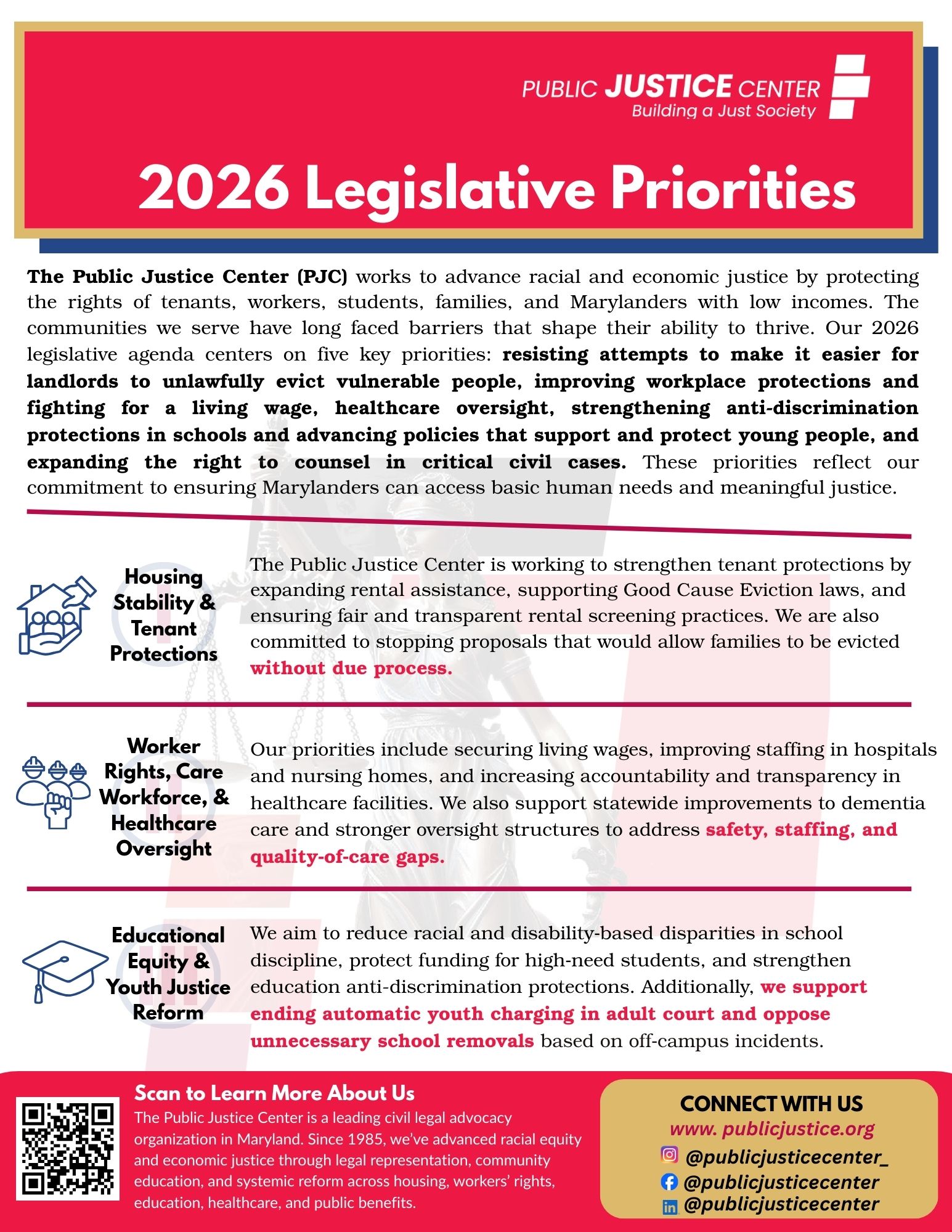
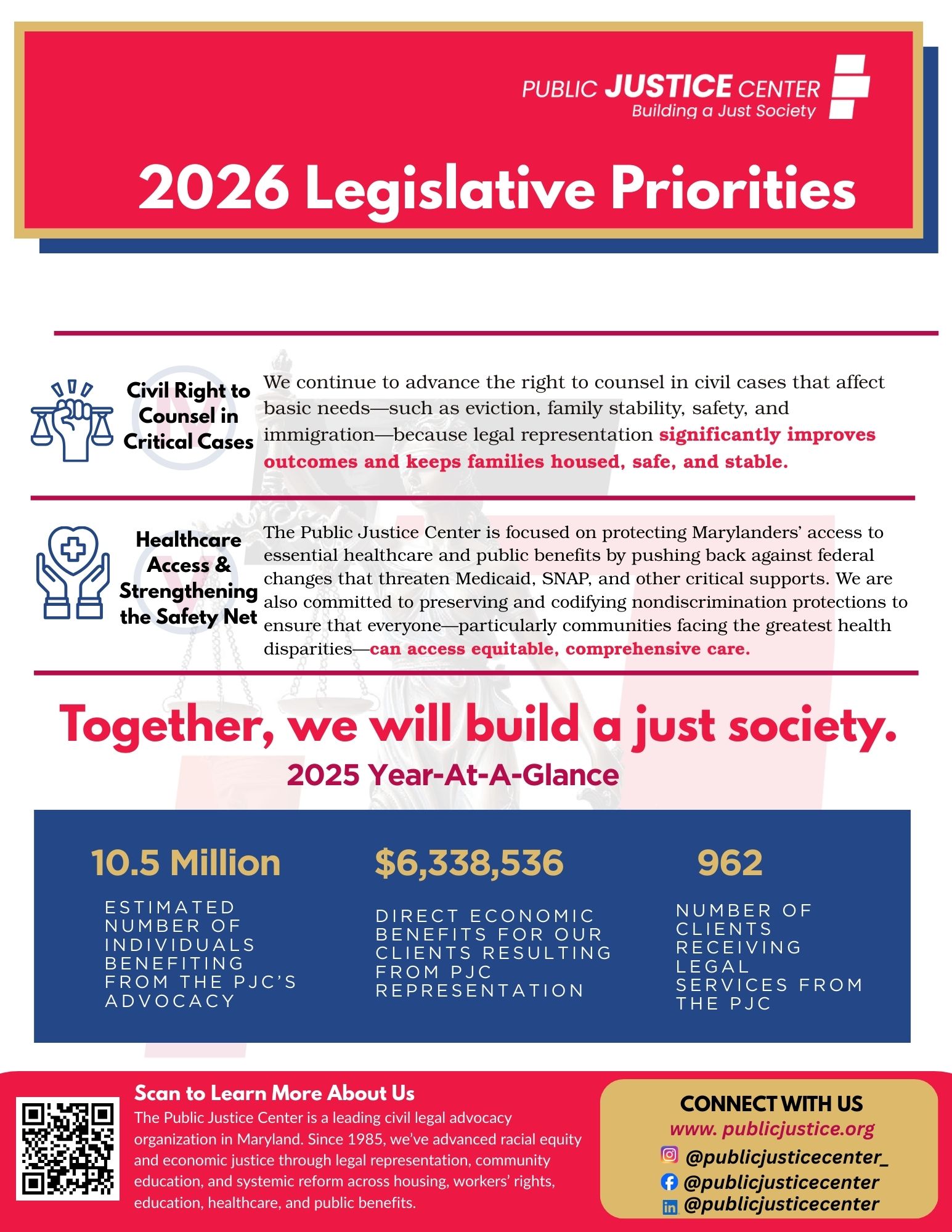
Human Right to Housing
Ensuring that individuals and families have access to safe, fair, stable, and affordable housing makes our communities safer and stronger. As a co-leader of Renters United Maryland (RUM), we’ll be focusing on legislative priorities that will create more stable homes and strong communities for all Marylanders.
Establishing local enabling legislation for Good Cause Eviction
Sponsors: Delegate Jheanelle Wilkins and Senator Anthony Muse
All Marylanders deserve the chance to put down roots in our communities, but for too long large corporate landlords have rigged the rules to their benefit – filing eviction cases against thousands of Maryland families each year without providing a reason.
This enabling legislation (SB 462 / HB 774) will allow local jurisdictions to pass Good Cause Eviction laws that prevent people from being evicted unless the landlord provides a legitimate reason. It is time to pass this legislation without amendments that would undermine existing renter protections.
Funding the Community Schools Rental Assistance Program fully
In 2024, the PJC and RUM were instrumental in passing legislation that created an eviction prevention funds program for families who have children in community schools. However, the program is critically underfunded, with $5 million allocated in the most recent budget. The program just launched and the need is overwhelming. Kids can’t learn if they slept in a homeless shelter the previous night or have to constantly transfer schools. Maryland should allocate at least $25 million to this program to help 6,000 residents avoid eviction.
Ensuring applications for rental housing are treated fairly
SB 937 / HB 1073 – Fair Chance in Housing Act – Senator Shaneka Henson and Delegate Robbyn Lewis
SB 335 / HB 315 – Ending Credit Barriers for Assisted Families – Senator Sara Love and Delegate Vaughn Stewart
HB 313 – Tenant Screening Transparency Act – Delegate Vaughn Stewart
One of the biggest barriers that renters face in seeking fair housing is the unfair rejection of their applications because of credit scores, rental history, or criminal history. Discriminatory tenant screening practices create artificial barriers that do not help determine whether a person will pay the rent. By restricting what information a landlord can use when verifying an applicant and ensuring that the information is correct, more Marylanders will be able to find a stable home.
Opposing “Evict first, ask questions later” bills
Fueled by a false narrative – manufactured by Sinclair-aligned media and agenda-driven think tanks – about squatters in Maryland, we are expecting the introduction of bills that would deprive tenants of a fair hearing before an eviction. Our coalition opposed this legislation last year, and we will oppose it again because every family deserves due process and a chance to tell their side of the story before any eviction. Bills include SB 82, HB 59, HB 765, and HB 847.
We will support the Rental Fraud Prevention Act – HB 1456, Del. Embry – that will require commercial internet platforms (e.g., Facebook Marketplace) to verify that posters are authorized to lease out the properties they advertise for rent.
Workplace Justice
Care should be at the heart of our healthcare system and workplaces. But too often, these systems are set up in ways that undermine the well-being of patients and workers. Truly caring for all Marylanders means ensuring a living wage for all workers; adequate staffing in hospitals; robust oversight of nursing homes, hospitals, and adult care facilities; more tools and resources for healthcare providers; and good wages and sick leave for care workers. Together with the Maryland Living Wage for All coalition, our Workplace Justice Project is advocating to increase the minimum wage to a level that enables people to support themselves and their families with no exceptions. With the Caring Across Maryland coalition, we are advocating for policies that bolster jobs for care workers, increase access to care, and improve transparency. Here’s what we’re working on this year in the Maryland General Assembly:
Maryland Living Wage for All
Maryland workers deserve to be paid enough to meet the cost of living. But Maryland’s current minimum wage of $15 per hour isn’t enough for individuals and families to afford necessities like housing, food, transportation, and healthcare. And the minimum wage for people who earn tips is even lower, a practice that is a direct legacy of slavery. As a member of the Maryland Living Wage for All coalition, we are advocating for legislation that would send a living wage amendment to the state constitution to the ballot in the 2026 general election. The amendment would permanently tie the state’s minimum wage to the cost of living and require all employers to pay employees at least the full minimum wage, eliminating the subminimum wage for tipped workers. The accompanying legislative proposal would increase the state minimum wage up to $25 per hour over time, and then every year after that, the minimum wage would automatically increase according to the cost of living.
Safe Staffing Act of 2026
Sponsors: Delegate Jennifer White Holland and Senator Malcolm August
Maryland hospitals face critical staffing shortages due to high staff turnover, poor working conditions, low pay, and shifting care delivery models. When hospitals assign nurses too many patients, the quality of care that people receive suffers. Nurses become burned out and are more likely to leave the profession. The Safe Staffing Act establishes hospital safe staffing committees comprised of 50% direct care workers at each hospital, which will help drive solutions to staffing and safety issues. This legislation allows hospitals to create staffing plans based on their unique needs. By creating safe staffing conditions, hospitals can retain experienced nurses, motivate people to join or come back to the profession, and help ensure patients get the care they need.
Nursing Home Staffing Crisis Funding Act of 2026
Sponsor: Delegate Ashanti Martinez
There is little transparency into – and oversight over – nursing home spending, which contributes to high staff turnover, substandard working conditions, and poor quality of care. Even though Medicaid reimbursement rates to providers have increased, frontline workers do not receive family-sustaining wages. Meeting patients’ medical needs requires an investment in training and wages for direct care workers. The Nursing Home Staffing Crisis Funding Act seeks to improve nursing homes’ fiscal transparency and ensure that a fair percentage of nursing home revenue is spent on direct resident care and wages and benefits for direct care workers. Ultimately, this legislation will improve jobs for direct care workers, most of whom are women, and improve safety, quality of care, and quality of life for nursing home residents.
Alzheimer’s Provider Education and Public Health Response
Sponsors: Delegate Ashanti Martinez and Senator Clarence Lam
Dementia affects thousands of Marylanders, but two critical players in reducing dementia – healthcare providers and our public health system – are inadequately equipped to meet the demand for care and reduce future dementia risk. Led by the Alzheimer’s Association, the PJC and our Caring Across Maryland coalition partners are championing legislation that strengthens care and invests in prevention. The bill will:
- establish a Clinical Toolkit for Dementia Care for providers;
- establish a Dementia Services and Brain Health Program within the Maryland Department of Health to lead prevention and coordinate statewide strategies in alignment with other diseases; and
- expand the Virginia I. Jones Alzheimer’s and Related Dementia Council’s role to assess healthcare provider readiness and advise the State on strategies to strengthen care.
The bill will ensure that healthcare providers get the tools and resources they need to provide care and to improve detection and access to treatment while fueling strategies that prevent dementia and reduce costs.
Stakeholder Advisory Council for the Maryland Office of Health Care Quality
Sponsors: Delegate Teresa Woorman and Senator Karen Lewis Young
The Maryland Office of Health Care Quality (OHCQ) is intended to provide oversight of our healthcare facilities, including hospitals, nursing homes, and adult day care. But OHCQ has failed to fulfill its mission, leading to Maryland having the longest ER wait time in the country, nursing homes not receiving annual inspections, adult day care centers failing federal inspections, and an alarming increase in medical errors in hospitals. Together with Marylanders for Patient Rights and the Caring Across Maryland coalition, we are advocating for a bill that would establish a Stakeholder Advisory Council for OHCQ that would provide constructive feedback to the agency to improve its regulation of healthcare in the state. Council membership would include frontline hospital workers, nursing home care workers, MedChi (the Maryland State Medical Society), a union representative from SEIU, patient advocates, disability rights organizations, behavioral health experts, representatives from the long-term care industry and the Maryland Hospital Association, state legislators, state agencies, and the Maryland Attorney General.
Minimum Home Care Wage and Paid Sick Leave
Sponsor: Delegate Heather Bagnall
While the demand for home care is high, home care workers receive very low wages, and many do not receive paid sick and safe leave. We are advocating for legislation that would require residential service agencies to increase home care workers’ wages to at least $20 per hour by 2030 and provide paid sick and safe leave to home care workers, regardless of the size of the agency. Living wages and paid leave are critical to all workers, and with our Caring Across Maryland Coalition partners, we are fighting for access to these supports for this high-demand, low-wage workforce.
Education Stability
Every child should have access to an education. But some school district disciplinary practices, state policies, and inadequate school funding can keep kids from succeeding in school. In this year’s legislative session, we plan to advocate for bills to strengthen education anti-discrimination protections, improve access to government data, ensure strong funding levels to support our schools, and reduce the instances of automatic charging of youth as adults. We will also push back against legislation that would prevent certain students from attending school.
Strengthening education anti-discrimination protections
Discrimination by educational institutions against students in protected classes—such as race, sex, sexual orientation, gender identity, disability, and national origin—deprives students of their fundamental right to education, stifles individual potential, and deepens societal inequity. We strongly support the Advancing Equal Educational Opportunities for All Students in Maryland Act, which fills the gap in civil rights enforcement created by the decimation of the U.S. Department of Education Office of Civil Rights. This legislation, which has been introduced by request of Governor Moore’s administration, largely mirrors anti-discrimination protections for students in federal law and gives the Maryland Commission on Civil Rights jurisdiction to resolve complaints against educational institutions, including public and nonpublic preK-12, postsecondary, and higher education institutions. The legislation also establishes a private right of action granting individuals the right to file a civil lawsuit if they believe that an educational institution has discriminated against a student and establishes that claims may be based upon both discriminatory intent and discriminatory impact. This legislation is necessary to ensure equitable access to education for all Maryland students and is a priority for the PJC’s Education Stability Project.
Improving access to government data
Our advocacy to combat the excessive and disparate use of exclusionary discipline by Maryland schools is guided by data analysis, but we often struggle to access critical data due to a lack of government transparency. We support legislation that would amend the Maryland Public Information Act to improve public access to data maintained in electronic databases. This legislation would result in access to data that can be used to inform policy and advance equity in education.
Ensuring adequate funding to support our schools
As an organizational member of the Blueprint Coalition, we support adequate school funding and equitable distribution of resources to ensure that all Maryland students have access to a quality education. Each year, Maryland invests billions of dollars in poverty-based funding to local school districts statewide through Compensatory Education and Concentration of Poverty funding. Maryland’s current methodology for determining allocation of this funding will expire in FY 2027. We support efforts to extend the current methodology, prevent adoption of any new methodology that reduces total statewide funding below current law baselines, and establish measures that account for the harmful effects of federal changes to SNAP and Medicaid eligibility, which would negatively impact the accuracy of Maryland’s funding methodology.
Youth Charging Reform Act
We support the Youth Charging Reform Act, legislation which improves access to education and interrupts the systemic racial inequities of the school-to-prison pipeline by reducing the number of criminal offenses for which 16 and 17-year-olds in Maryland are automatically charged as adults and ending automatic charging of 14- and 15-year-olds as adults. Almost 80 percent of youth automatically charged as adults in Maryland are Black, and more than 60 percent of cases are ultimately waived down to the juvenile system after youth have already experienced the harm and trauma of the adult system. While the PJC supports ending the automatic charging of youth as adults completely, we are in solidarity with Leaders of a Beautiful Struggle, the Maryland Youth Justice Coalition, the Maryland Alliance for Racial Equity in Education, and other advocates in strong support of this legislation that significantly limits automatic charging.
Fighting fearmongering and advocating for access to school for all kids
We expect to engage in significant defensive advocacy against legislation that would make harmful changes to Maryland’s “reportable offense” law, which allows school districts to remove a student based on an arrest or charge for alleged criminal conduct outside of school. School districts have frequently removed students for long periods of time for reportable offenses that had no connection to or impact on the school community, disrupting students’ education, even when a court has determined that the student is safe to be in the community.
Health and Benefits Equity
The PJC believes that access to healthcare and safety net services are human rights. Many systemic barriers keep people from attaining their highest level of health. We advocate to protect and expand access to healthcare and safety net services for Marylanders struggling to make ends meet. We support policies and practices that are designed to eliminate economic and racial inequities and enable every Marylander to attain their highest level of health. With rising costs of food, housing, utilities, healthcare, and other core necessities, it’s crucial that our safety net services like Medicaid, Supplemental Nutrition Assistance Program (SNAP) and Temporary Cash Assistance Program (TCA) are responsive to real-time needs of individuals and families with limited financial means.
Defending safety net services from deep cuts to minimize the impact of federal changes on Marylanders
Across the state, hundreds of thousands of people are projected to lose health coverage and food assistance. Recent changes to federal law severely cut SNAP and Medicaid funding, create harsh and ineffective new work requirements in both programs, and restrict eligibility for most immigrants. This puts Maryland in the difficult position of finding millions more in state funding and reducing the support that the safety net provides to individuals and families in crisis. During the Maryland legislative session, we’ll oppose state cuts to Medicaid and the budget for the Department of Human Services (which administers benefits programs), as well as opposing restrictions that would limit people’s eligibility.
Increasing access to Temporary Cash Assistance for families with children
Sponsor: Delegate Emily Shetty
We support trauma-informed policy reforms to Maryland’s safety net services to ensure that no individual or family goes without the support they need during times of crisis. When an individual applies for the Temporary Cash Assistance program, they are generally required to apply for child support and to cooperate with the child support enforcement agency to establish a child support order against a noncustodial parent. This requirement has led to denials, benefits reductions, and terminations for PJC clients who are unable to pursue child support, for example due to domestic violence or safety concerns or when not in the best interest of the child. We will advocate in support of HB 1490 to expand the good cause exceptions for when an individual would not be required to pursue child support as a condition of receiving TCA. We are also advocating for the Department of Human Services to notify families applying for TCA of the availability of good cause exceptions, how to receive them, and to assist the family in obtaining them.
Protecting federal anti-discrimination protections for healthcare access in Maryland’s law
Unpredictable changes at the federal level to longstanding anti-discrimination laws leave Marylanders vulnerable to losing access to comprehensive healthcare and could exacerbate health disparities. The PJC will support legislation that preserves federal protections in healthcare settings, like the right to language access for individuals with limited English proficiency and access to mental health and substance use disorder treatment, so that all Marylanders can achieve their highest level of health.
Civil Right to Counsel
The PJC tracks relevant civil right to counsel legislation around the country as the facilitator of the National Coalition for a Civil Right to Counsel (NCCRC). The NCCRC is the only project in the country dedicated solely to advancing the right to counsel in critical civil cases. Legal counsel in life-changing civil cases makes a difference: represented individuals are more likely to remain housed, secure protective orders in domestic violence cases, and avoid immigration removal. In 2026, we will track legislation at the federal, state, and city levels that would enact, change, or repeal a right to counsel in our key areas, which include housing (primarily eviction cases), family law, domestic violence, immigration, health, civil forfeiture, civil incarceration, and education.
As of February 2026, the NCCRC is paying close attention to the following:
- Tenant Right to Counsel. The tenant right to counsel movement continues to advance around the country, with the City of Los Angeles and Bozeman, MT, becoming the latest to enact such a right in 2025. Bills in New York (NY A01086) and Massachusetts (MA H4063) have crossed over to the 2026 legislative session and would establish statewide right to counsel for tenants facing eviction. New York has also introduced statewide legislation (NY A01576) to provide a 14-day continuance (postponement of the court date) to tenants who are entitled to, but unable to secure, counsel. In Indiana, HB1181 would establish a task force for the state to assess establishment of a statewide tenant right to counsel. For city-level tenant right to counsel enactments, we believe ordinances may be introduced or move further forward in Nashville, TN; Milwaukee, WI; Long Beach, CA; and Springfield, MO. We are also tracking whether jurisdictions that have a right to counsel are implementing the law as written.
- Family Law. While most states provide a right to counsel for parents in child welfare and termination of parental rights (TPR) proceedings, some still do not. A right to counsel for children in TPR proceedings, and for parents and children in other types of custody proceedings (such as guardianship) similarly exists in some states and not others. In most years, we get involved in at least a few family law bills and partner with the National Association of Counsel for Children on efforts related to children in child welfare proceedings. In 2026, we may be assisting legislative efforts in Florida, Idaho (which repealed its right to counsel for parents in 2025), Washington State, Iowa, and Oregon.
- Civil Forfeiture. Civil forfeiture laws allow government entities to confiscate and retain individual property allegedly connected to a criminal case or investigation, even without a criminal conviction. There is often no right to counsel in these cases. Vermont has reintroduced legislation (H0592) to provide a right to counsel for people in civil forfeiture cases, while bills are pending from last year in Illinois, Massachusetts, Minnesota, and New Hampshire.
- Immigration. Immigration proceedings and the lack of a right to counsel in these cases came to the forefront in 2025. While the federal administration tried to strip individuals of legal representation in immigration cases by cancelling contracts with legal services providers, and while Texas sued local jurisdictions for trying to provide immigrants with legal representation, California became the first state to enact a statewide right to counsel for children facing immigration cases. New York has reintroduced legislation (AB 270) to establish a right to counsel in immigration cases, and numerous bills have been filed in the past several years to create such a right at the federal level.
Visit the NCCRC’s website for news or legislative updates (the latter of which can be found on the status map’s Recent Activity view or in the list of active legislation). The website is continually updated as bills are introduced, and 2026 legislative developments are forthcoming. Local ordinances do not appear on the legislative developments page or on the status map unless they have been enacted.


